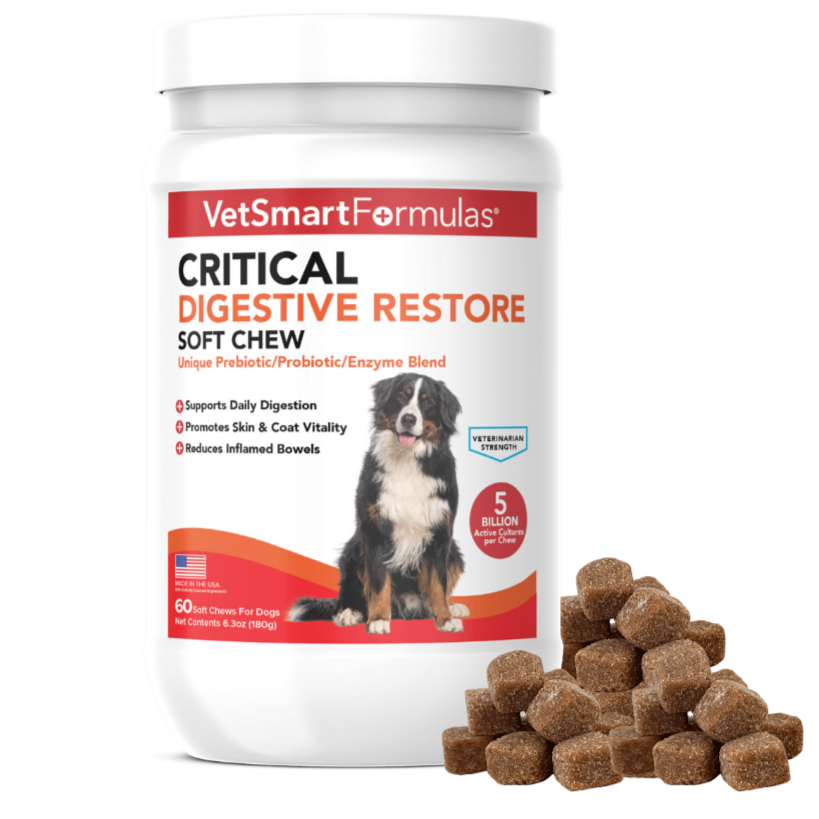
Critical Digestive Restore delivers 5 billion CFU of two spore-forming Bacillus probiotics per chew, with a chicory-root prebiotic (FOS), digestive enzymes, pumpkin and broccoli seed. Below is the independent research on those ingredients, with the species each study was carried out in.
Bacillus coagulans and Bacillus subtilis (spore-forming probiotics)
Bacillus spores survive manufacturing, storage and stomach acid, which is why they suit a shelf-stable chew. Both species have been tested directly in dogs. Bacillus coagulans produced firmer stools and more Faecalibacterium (a beneficial butyrate producer) in healthy dogs, with no adverse effects across graded doses. Bacillus subtilis was safe at up to 5 billion CFU per day in beagles, reduced fecal odor and protein-breakdown compounds in one study, and improved oxidative-stress markers in a randomized placebo-controlled trial. The European Food Safety Authority has judged a Bacillus subtilis strain safe for dogs. A 2024 study found Bacillus subtilis plus Bacillus coagulans spores improved immune markers and healing in dogs with an induced skin condition.
Research:
- Wilson SM (2025). Effects of Bacillus coagulans (GBI-30, 6086) supplementation on apparent total tract nutrient digestibility and the fecal characteristics and metabolites, immunity, and microbiota of healthy adult dogs. J Anim Sci. Study population: Dogs (12 healthy adult English Pointers). PubMed
- Acuff (2021). Evaluation of graded levels of Bacillus coagulans GBI-30 6086 on apparent nutrient digestibility stool quality and intestinal health indicators in healthy adult dogs. J Anim Sci. Study population: Dogs (healthy adults). PubMed
- Oba PM (2025). Effects of Bacillus subtilis ATCC PTA-122264 on apparent total tract macronutrient digestibility and fecal characteristics, metabolites, and microbiota of healthy adult dogs. J Anim Sci. Study population: Dogs (12 healthy adult beagles). PubMed
- Bastos (2020). Bacillus subtilis and Bacillus licheniformis reduce faecal protein catabolites concentration and odour in dogs. BMC Vet Res. Study population: Dogs. PubMed
- Allenspach (2023). Effect of the Probiotic Bacillus subtilis DE-CA9 on Fecal Scores Serum Oxidative Stress Markers and Fecal and Serum Metabolome in Healthy Dogs. Vet Sci. Study population: Dogs (healthy beagles). PubMed
- EFSA FEEDAP Panel (2017). Safety and efficacy of Calsporin (Bacillus subtilis DSM 15544) as a feed additive for dogs. EFSA J. Study population: Dogs. PubMed
- Khosravi M (2024). Effect of Bacillus subtilis and Bacillus coagulans spores on induced allergic contact dermatitis in dogs. Vet Med Sci. Study population: Dogs. PubMed
Probiotics for stool quality and digestive upsets
Independent trials in dogs show selected probiotics can shorten episodes of loose stool. In a 148-dog study across 14 veterinary practices, a probiotic paste shortened diarrhea by about 15 hours and sped recovery 1.6-fold; in 120 puppies, a Lactobacillus probiotic normalized stools faster; and in 111 dogs, a Bacillus plus FOS diet returned stools to normal in 3.6 days versus 5.9 on a control diet. A 2024 trial found a synbiotic matched metronidazole clinically while sparing the gut microbiome. Not every trial is positive: current European veterinary guidelines (ENOVAT) find the overall effect on diarrhea duration small and uncertain, and recommend probiotics and diet as supportive care rather than treatment. That is how we position this product.
Research:
- Nixon SL (2019). Efficacy of an orally administered anti-diarrheal probiotic paste (Pro-Kolin Advanced) in dogs with acute diarrhea: A randomized, placebo-controlled, double-blinded clinical study. J Vet Intern Med. Study population: Dogs (148 client owned, 14 practices). PubMed
- Molina RA (2023). A multi-strain probiotic promoted recovery of puppies from gastroenteritis in a randomized, double-blind, placebo-controlled study. Can Vet J. Study population: Dogs (120 puppies, 1 to 4 months). PubMed
- Jeusette I (2025). A new highly digestible prescription diet containing Bacillus velezensis DSM 15544, fructo-oligosaccharides, plasma immunoglobulin, yeast and sepiolite for the management of acute diarrhea in dogs, a randomized double-blinded, controlled trial. Front Vet Sci. Study population: Dogs. PubMed
- Stubing H (2024). The Effect of Metronidazole versus a Synbiotic on Clinical Course and Core Intestinal Microbiota in Dogs with Acute Diarrhea. Vet Sci. Study population: Dogs (27 with acute diarrhea). PubMed
- Herstad (2010). Effects of a probiotic intervention in acute canine gastroenteritis: a controlled clinical trial. J Small Anim Pract. Study population: Dogs (acute gastroenteritis). PubMed
- Gomez-Gallego (2016). A canine-specific probiotic product in treating acute or intermittent diarrhea in dogs: a double-blind placebo-controlled efficacy study. Vet Microbiol. Study population: Dogs (diarrhea). PubMed
- Jessen LR (2024). European Network for Optimization of Veterinary Antimicrobial Therapy (ENOVAT) guidelines for antimicrobial use in canine acute diarrhoea. Vet J. Study population: Dogs. PubMed
- Scahill K (2024). Efficacy of antimicrobial and nutraceutical treatment for canine acute diarrhoea: A systematic review and meta-analysis for European Network for Optimization of Antimicrobial Therapy (ENOVAT) guidelines. Vet J. Study population: Dogs. PubMed
Fructooligosaccharides (FOS) from chicory root
FOS is a well-studied prebiotic fiber in both dogs and cats. In dogs, FOS increased fecal bifidobacteria and improved nutrient digestibility, inulin-type fructans raised short-chain fatty acids, and the smallest FOS component (kestose) pushed Clostridium perfringens below detection while increasing butyrate. In cats, inulin raised secretory IgA (a gut immune marker) and kestose increased bifidobacteria and butyrate producers. Laboratory work with canine gut bacteria shows FOS is highly fermentable into short-chain fatty acids, which feed the cells lining the colon.
Research:
- Pinna C (2018). Influence of dietary protein and fructooligosaccharides on fecal fermentative end-products, fecal bacterial populations and apparent total tract digestibility in dogs. BMC Vet Res. Study population: Dogs (12 healthy adults). PubMed
- Alexander C (2018). Effects of prebiotic inulin-type fructans on blood metabolite and hormone concentrations and faecal microbiota and metabolites in overweight dogs. Br J Nutr. Study population: Dogs (9 overweight beagles). PubMed
- Ide K (2020). Kestose supplementation exerts bifidogenic effect within fecal microbiota and increases fecal butyrate concentration in dogs. J Vet Med Sci. Study population: Dogs (6 healthy beagles). PubMed
- Liang SK (2024). Effects of inulin on fecal microbiota and specific immunity in cats. Res Vet Sci. Study population: Cats. PubMed
- Shinohara M (2020). Activation of butyrate-producing bacteria as well as bifidobacteria in the cat intestinal microbiota by the administration of 1-kestose, the smallest component of fructo-oligosaccharide. J Vet Med Sci. Study population: Cats. PubMed
- Vickers (2001). Comparison of fermentation of selected fructooligosaccharides and other fiber substrates by canine colonic microflora. Am J Vet Res. Study population: Canine colonic microflora (in vitro). PubMed
- Willard (2000). Effects of dietary fructooligosaccharide on selected bacterial populations in feces of dogs. Am J Vet Res. Study population: Dogs. PubMed
Digestive enzymes, pumpkin and broccoli seed
The enzyme blend (amylase, cellulase, papain, bromelain and lipase) targets starch, fiber, protein and fat. In a simulated canine digestion model, adding a multi-enzyme blend to kibble raised dry-matter digestibility by about 19 percent, and a bromelain-containing supplement lowered a fecal inflammation marker in kennel dogs. Pumpkin contributes soluble fiber of the kind that, in larger amounts, has improved stool quality in dogs. Broccoli seed supplies sulforaphane glucosinolate; dogs absorb sulforaphane after oral dosing, and in canine intestinal cells it switches on genes in antioxidant and inflammatory-response pathways.
Research:
- Jadhav S (2023). Modulation of digestibility of canine food using enzyme supplement: an in vitro simulated semi-dynamic digestion study. Front Vet Sci. Study population: Simulated canine digestion, in vitro. PubMed
- Atuahene (2023). A Supplement with Bromelain, Lentinula edodes, and Quercetin: Antioxidant Capacity and Effects on Morphofunctional and Fecal Parameters in Kennel Dogs. Vet Sci. Study population: Dogs (kennel). PubMed
- Liang D (2025). Dietary supplementation with soluble corn fiber improved fecal score, microbiota, and SCFAs in dogs. Front Vet Sci. Study population: Dogs (20 adults). PubMed
- Alves JC (2021). The use of soluble fibre for the management of chronic idiopathic large-bowel diarrhoea in police working dogs. BMC Vet Res. Study population: Dogs (22 working dogs). PubMed
- Curran KM (2018). Sulforaphane absorption and histone deacetylase activity following single dosing of broccoli sprout supplement in normal dogs. Vet Med Sci. Study population: Dogs (healthy). PubMed
- Li (2024). Transcriptome analysis provides new insights into the response of canine intestinal epithelial cells treated by sulforaphane. Front Vet Sci. Study population: Canine intestinal epithelial cells. PubMed
For veterinarians
The current evidence for probiotics in canine acute diarrhea is summarised in Jensen and Bjornvad 2019 and the ENOVAT systematic review and guideline (Scahill 2024, Jessen 2024): low-certainty evidence of little or no clinically significant effect on duration, no adverse effects, and a strong recommendation against routine antimicrobials. We position Critical Digestive Restore accordingly, as microbiome-supportive care. Two 2025 abrupt-diet-change studies from the University of Illinois found that neither Bacillus coagulans nor Bacillus subtilis spores prevented diet-induced dysbiosis in healthy dogs, so the product should not be relied on for that purpose. The label identifies both Bacillus species but not strain designations; strain-level results (for example GBI-30, 6086 or DE-CA9) therefore support biological plausibility rather than product-specific efficacy. Enzyme supplementation has an established indication only in exocrine pancreatic insufficiency; the in-vitro digestibility data cited are manufacturer-authored. Pumpkin (50 mg) and broccoli seed (25 mg) are supportive inclusions at amounts well below any studied dose.
About this research
Critical Digestive Restore is a nutritional supplement, not a drug. The studies above were conducted by independent researchers on individual ingredients, not on the finished VetSmart Formulas product, and are provided so that pet owners and veterinarians can read the evidence for themselves. Results in one species or preparation do not guarantee the same result in another. This information is not intended to diagnose, treat, cure or prevent any disease. If your pet has a diagnosed condition or takes medication, talk to your veterinarian before adding a supplement.