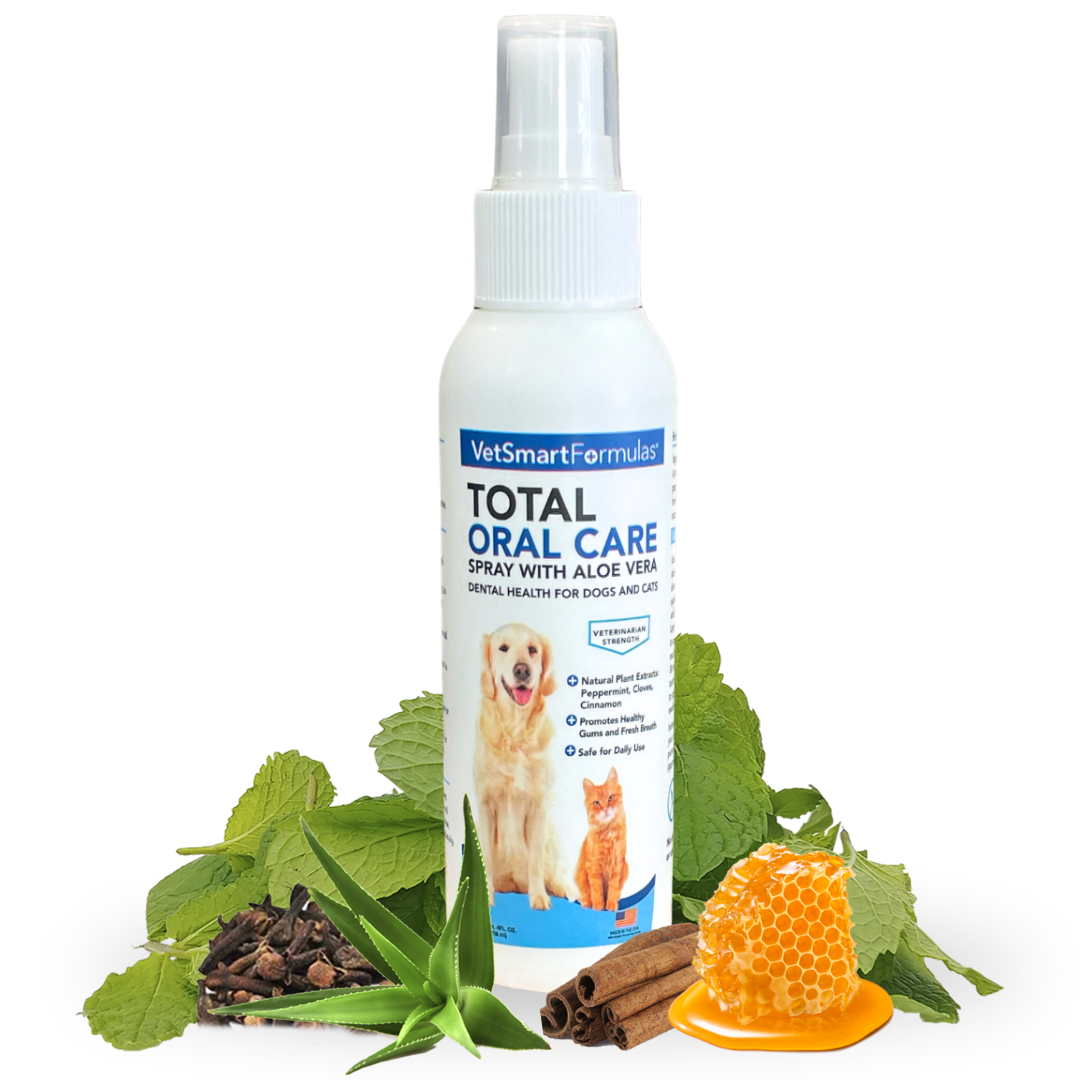
Total Oral Care Spray is a no-brush oral spray for dogs and cats made from distilled water, peppermint extract, cinnamon, natural honey, cloves and aloe vera. Periodontal disease is the most common diagnosis in cats and is found in most adult dogs on examination. Below is the independent research on the spray's ingredients and on no-brush oral care in pets, with the species each study was carried out in.
Why oral care matters for dogs and cats
In a study of 18,249 cats in UK primary care, periodontal disease was the most common specific diagnosis, with 15 percent of cats affected in a single year. In dogs, primary-care records show periodontal disease in 9 to 18 percent, but detailed examination under anaesthesia finds it in 44 to 100 percent of adult dogs.
Research:
- O'Neill (2023). Periodontal disease in cats under primary veterinary care in the UK: frequency and risk factors. Journal of Feline Medicine and Surgery. Study population: Cats (18,249 UK primary care cats). PubMed
- Wallis (2020). A review of the frequency and impact of periodontal disease in dogs. Journal of Small Animal Practice. Study population: Dogs. PubMed
Cinnamon, clove and peppermint
These plant oils have been studied against Porphyromonas gingivalis, the bacterium behind gum disease in people and a close relative of Porphyromonas gulae, the main periodontal pathogen in dogs and cats. Cinnamon bark oil inhibited P. gingivalis at very low concentrations, damaged its membrane and reduced biofilm formation by 75 percent. Clove's main component, eugenol, killed P. gingivalis by breaking its cell membrane and switched off virulence genes. A blend containing peppermint and clove oils inhibited P. gingivalis, and in an early survey of plant oils peppermint was among the most potent against oral bacteria. A 1 percent cinnamaldehyde mouthwash reduced a human saliva biofilm as effectively as chlorhexidine in a laboratory model.
Research:
- Wang (2018). Antibacterial effects of cinnamon (Cinnamomum zeylanicum) bark essential oil on Porphyromonas gingivalis. Microbial Pathogenesis. Study population: Porphyromonas gingivalis, in vitro. PubMed
- Zhang (2017). Antibacterial and antibiofilm activities of eugenol from essential oil of Syzygium aromaticum (clove) leaf against periodontal pathogen Porphyromonas gingivalis. Microbial Pathogenesis. Study population: Porphyromonas gingivalis, in vitro. PubMed
- Kumar (2023). Antimicrobial Efficacy of Blended Essential Oil and Chlorhexidine against Periodontal Pathogen (P. gingivalis), An In Vitro Study. Nigerian Journal of Clinical Practice. Study population: Porphyromonas gingivalis, in vitro. PubMed
- Shapiro (1994). The antimicrobial activity of essential oils and essential oil components towards oral bacteria. Oral Microbiology and Immunology. Study population: Anaerobic and facultative oral bacteria, in vitro. PubMed
- D'Assuncao (2025). Antimicrobial effect of cinnamaldehyde in a peri-implant mucositis model. Archives of Oral Biology. Study population: Human saliva derived polymicrobial biofilm, in vitro. PubMed
- Huang (2026). Research progress and antibacterial mechanisms of plant essential oils as alternative therapies for periodontitis. Frontiers in Microbiology. Study population: Periodontal pathogens, review of in vitro work. PubMed
Natural honey
Honey is naturally antibacterial. Manuka honey at 2 percent inhibited half of the P. gingivalis strains tested in the laboratory, and medical-grade honey was bactericidal against bacteria isolated from dog and cat wounds. In people, adding a manuka honey rinse to professional cleaning gave greater gains in gum attachment at six months than saline in a 140-patient randomized trial, and small extra improvements in a split-mouth study.
Research:
- Eick (2014). Honey, a potential agent against Porphyromonas gingivalis: an in vitro study. BMC Oral Health. Study population: Porphyromonas gingivalis. PubMed
- Neo (2024). Medical-grade honey has superior antibacterial properties against common bacterial isolates in wound cultures of dogs and cats in comparison to non-medical-grade honey types. American Journal of Veterinary Research. Study population: Bacterial isolates from dog and cat wounds, in vitro. PubMed
- Abou-Bakr (2026). Adjunctive Manuka Honey Oral Rinse in Nonsurgical Periodontal Therapy for Hemodialysis Patients: A Randomized Controlled Clinical Study. Journal of Evidence-Based Dental Practice. Study population: Humans. PubMed
- Opsivac (2023). Therapeutic Manuka Honey as an Adjunct to Non-Surgical Periodontal Therapy: A 12-Month Follow-Up, Split-Mouth Pilot Study. Materials. Study population: Humans. PubMed
Aloe vera
Aloe vera is included to soothe gum tissue. In randomized human trials, an aloe vera mouthwash reduced plaque, gingival and bleeding scores, and a 2025 meta-analysis found aloe added to professional cleaning reduced pocket depth over 12 months. In pets, aloe sped wound healing in dogs and cats and improved periodontal tissue regeneration in a surgical study in dogs.
Research:
- Kamath (2023). Comparison of antiplaque and anti-gingivitis effects of aloe vera mouthwash with chlorhexidine in fixed orthodontic patients, A randomized controlled trial. International Journal of Dental Hygiene. Study population: Humans (30 orthodontic patients). PubMed
- Xie (2025). Clinical Effect of Local Aloe Vera Use as an Adjunct to Periodontal Therapy: A Systematic Review and Meta-Analysis. Journal of Evidence-Based Dental Practice. Study population: Humans (3 RCTs pooled). PubMed
- Drudi (2018). Aloe barbadensis miller versus silver sulfadiazine creams for wound healing by secondary intention in dogs and cats: A randomized controlled study. Research in Veterinary Science. Study population: Dogs and cats. PubMed
- Taalab (2023). Histologic and histomorphometric evaluation of Aloe vera adjunctive to beta-tricalcium phosphate in class II furcation defects in dogs. Scientific Reports. Study population: Dogs. PubMed
No-brush oral care in dogs
Daily no-brush products can help. In a randomized study of 40 dogs after dental scaling, a daily plant-extract water additive halved plaque scores and lowered calculus compared with controls. A once-daily plant polyphenol mouth spray lowered gingival, plaque and calculus indices in 38 healthy dogs, and a plant-extract gel improved gingivitis scores in dogs with P. gulae-related periodontitis. Brushing and dental chews remain the most effective home care, and professional cleaning cannot be replaced by any spray; Total Oral Care Spray is designed for the dogs and cats that will not tolerate a toothbrush.
Research:
- Gawor (2023). A water additive with pomegranate can reduce dental plaque and calculus accumulation in dogs. Frontiers in Veterinary Science. Study population: Dogs (40, after scaling). PubMed
- Thongma (2023). Influence of Gallic Acid-Containing Mouth Spray on Dental Health and Oral Microbiota of Healthy Dogs: A Pilot Study. Veterinary Sciences. Study population: Dogs (38, healthy). PubMed
- Miyamoto (2025). Bactericidal and Anti-Inflammatory Effects of Ashitaba-Extract Ameliorate the Gingivitis and Halitosis in Dogs with Porphyromonas gulae-Infected Periodontal Disease. Veterinary Sciences. Study population: Dogs with P. gulae periodontal disease, plus canine cell lines. PubMed
For veterinarians
No controlled study in dogs or cats has tested peppermint, cinnamon, clove, honey or aloe for plaque, calculus or halitosis; the ingredient evidence is in vitro against P. gingivalis and from human mouthwash trials, and the canine studies cited for no-brush formats used other plant extracts. Honest negatives: a 3-day honey rinse did not beat saline on plaque in people (Reduan 2025), aloe was the weakest active mouthwash in a 60-patient head-to-head trial (Andhare 2024), and in unscaled dogs only mechanical action (brushing, chews) reduced deposits (Gawor 2025). Essential oils at high concentration are toxic to cats, who lack efficient glucuronidation (Khan 2014: 106 cats exposed to neat tea tree oil); the spray uses dilute extracts and no case report exists at spray concentrations, but concentrations should be kept low and disclosed. The aloe used is inner-leaf gel; whole-leaf latex is a laxative and is listed as toxic to pets. The spray contains no xylitol.
About this research
Total Oral Care Spray is an oral care product, not a drug. The studies above were conducted by independent researchers on individual ingredients, not on the finished VetSmart Formulas product, and are provided so that pet owners and veterinarians can read the evidence for themselves. Results in one species or preparation do not guarantee the same result in another. This information is not intended to diagnose, treat, cure or prevent any disease. If your pet has a diagnosed condition or takes medication, talk to your veterinarian before adding a supplement.